
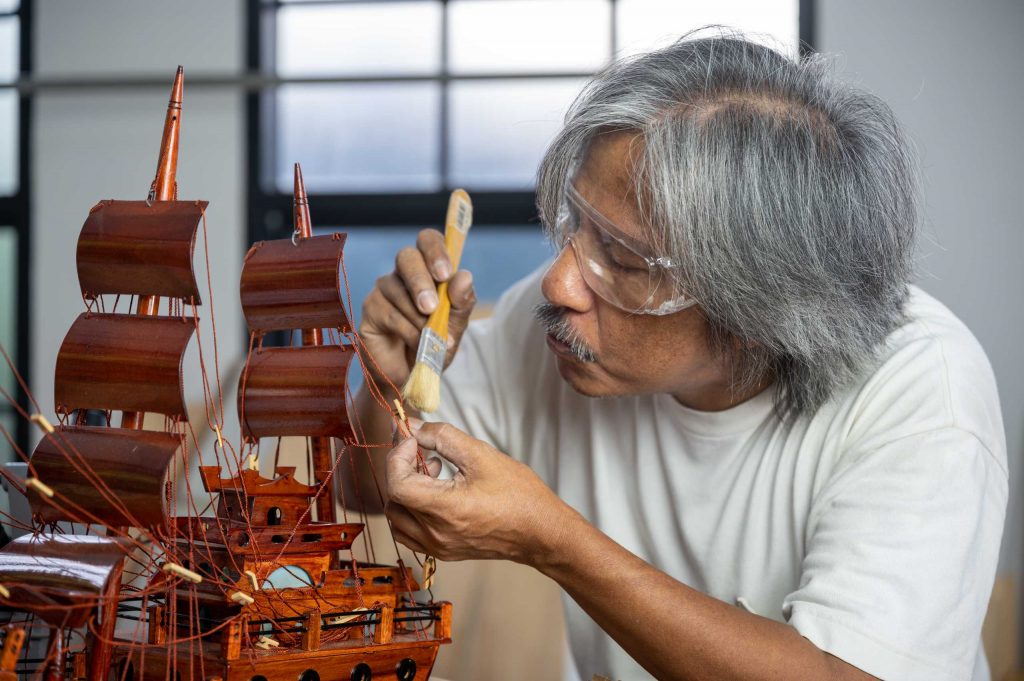
While model building precision is often mistakenly equated with trying to be perfect, these two concepts are actually quite distinct. Perfection is an absolute state which is attained (or not), whereas precision is something that is practiced and developed. Perfection is often an impediment to making progress because if one is trying to be perfect, then he is less likely to take the risk of creating a mistake that cannot be corrected. If one is instead practicing precision, then he acknowledges that getting things right often involves incremental refinement which is best achieved through attention to detail, careful work, and repeated attempts; none of which necessarily have to be done in a long unbroken chain of success.
It is in the preparation phase that precision begins to manifest itself. Before any two parts are mated together, they should be inspected along with the corresponding mating surfaces, and the points at which they will connect. This is the quiet part of the model building process, but it lays the groundwork for precision as the process progresses. Measuring parts, and mating surfaces twice; testing how parts fit together, and mentally running through the order of operations as a part is attached will all reduce the likelihood of mistakes later on. These steps do not prevent every single error, but they greatly reduce the likelihood of errors which in turn makes fixing the errors which do occur far more manageable.
Once assembly is underway, practicing precision manifests itself in simply not using too much glue, or too much force, or too much sandpaper. It is often the case that trying to correct a mistake too aggressively will introduce more problems than the original error. As a builder practices precision, he will begin to recognize when to stop applying force, and to just let the parts do what they want. This will lead to better fitting joints, cleaner surfaces, and better strength in the assemblies without having to force it. As the builder’s hands gain experience, they will begin to respond to the little cues of force, feel, and sight which will tell them that they have done enough.
While mistakes will still happen, one of the beautiful things about practicing precision is that these mistakes are immediately used as reference points rather than simply being a point of frustration. Builders who practice precision learn to evaluate the nature of the mistake, rather than berating themselves for their lack of skill. The part doesn’t quite fit in this orientation, so perhaps I have them reversed? Perhaps they need to be aligned in a particular fashion before they are glued in place? Perhaps I need to do one of them first? Etc. Practicing precision allows the builder to step back, and evaluate what he needs to do to correct the mistake, and incorporate these things into future activities. Each time he corrects a mistake in this fashion, he is practicing precision which will serve him well into the future. Over time, this will lead to tangible, visible results as his skills improve, and it will feel as though he has earned these improvements.